Azelia monodactyla
Taxonomy
This page represents the following TreeOfLife-200M taxonomic path.[1]
- Kingdom: Animalia
- Phylum: Arthropoda
- Class: Insecta
- Order: Diptera
- Family: Muscidae
- Genus: Azelia
- Species: Azelia monodactyla
Visual Description
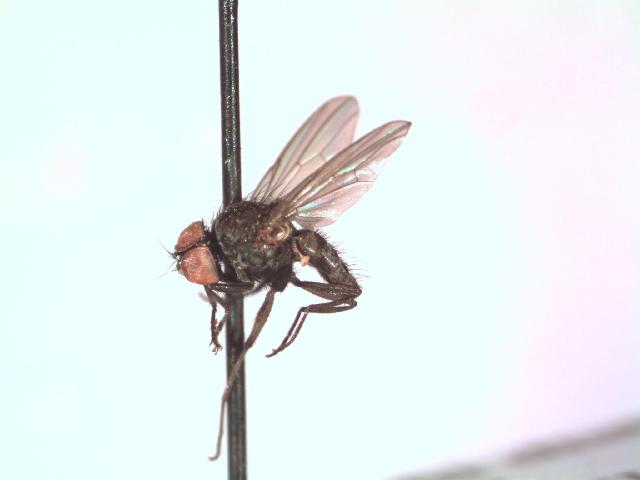
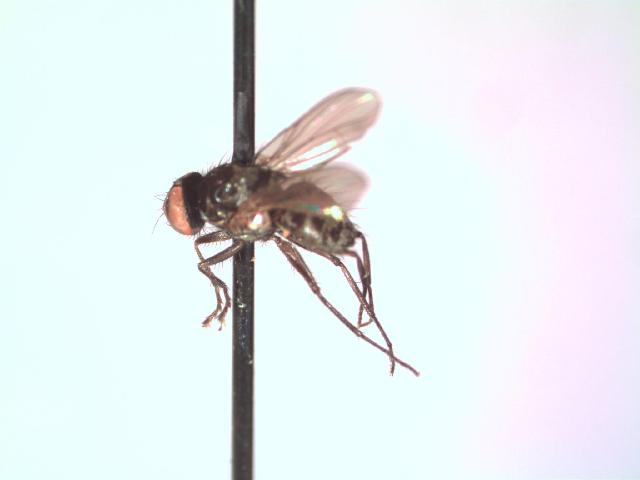
Azelia monodactyla is a small muscid fly, with adults typically measuring between 3.0 mm and 3.5 mm in length. The species exhibits sexual dimorphism. Males are characterized by bare eyes, a narrow frons, and black antennae where the third segment is approximately twice the length of the second. The scutum is black, and the prosternum and propleuron are bare. A diagnostic feature of the male is the presence of asymmetrical claws on the fore leg. The male abdomen is densely covered with grayish pollen, featuring a dark pattern on the anterior half of the second tergite, a pair of circular spots on the sides of the third to fifth tergites, and a tongue-shaped marking on the middle part. Females are slightly larger (3.0–3.5 mm), possess a wider frons (0.37–0.45 of head width), and have a grayish abdomen that appears paler than that of the male.[2]
Ecology and Distribution
In Japan, where it is known by the Japanese name "Maguso-chibi-funbae," A. monodactyla has been recorded in Hokkaido and the Tohoku district. Adults are frequently observed on horse dung, which is considered a primary breeding source, though the species has also been confirmed to occur on cow dung.[2] The species was originally described by Loew in 1874.[3][4]
Gallery
References
- ↑ Dataset view for Animalia / Arthropoda / Insecta / Diptera / Muscidae / Azelia / monodactyla constructed from imageomics/TreeOfLife-200M records under this taxonomic path. Hugging Face Datasets. https://huggingface.co/datasets/imageomics/TreeOfLife-200M.
- 1 2 Satoshi SHINONAGA; Rokurō Kanō; Tsutomu HASEGAWA. Studies on the flies occurring from the excrements of pasturing cattle and other herbivorous animals : 4. Two newly recorded Azelia-species from Japan. Medical Entomology and Zoology. 1975. https://doi.org/10.7601/mez.26.189.
- ↑ Azelia monodactyla Loew 1874 - Plazi TreatmentBank. Plazi TreatmentBank. http://tb.plazi.org/GgServer/xhtml/03AC87D4BF44D1778597F9E62F964F27. Accessed 2026-07-14.
- ↑ Azelia monodactyla Loew, 1874. GBIF. https://www.gbif.org/species/1529826. Accessed 2026-07-16.