Axos cliftoni
Taxonomy
This page represents the following TreeOfLife-200M taxonomic path.[1]
- Kingdom: Animalia
- Phylum: Porifera
- Class: Demospongiae
- Order: Tethyida
- Family: Hemiasterellidae
- Genus: Axos
- Species: Axos cliftoni
Visual Description
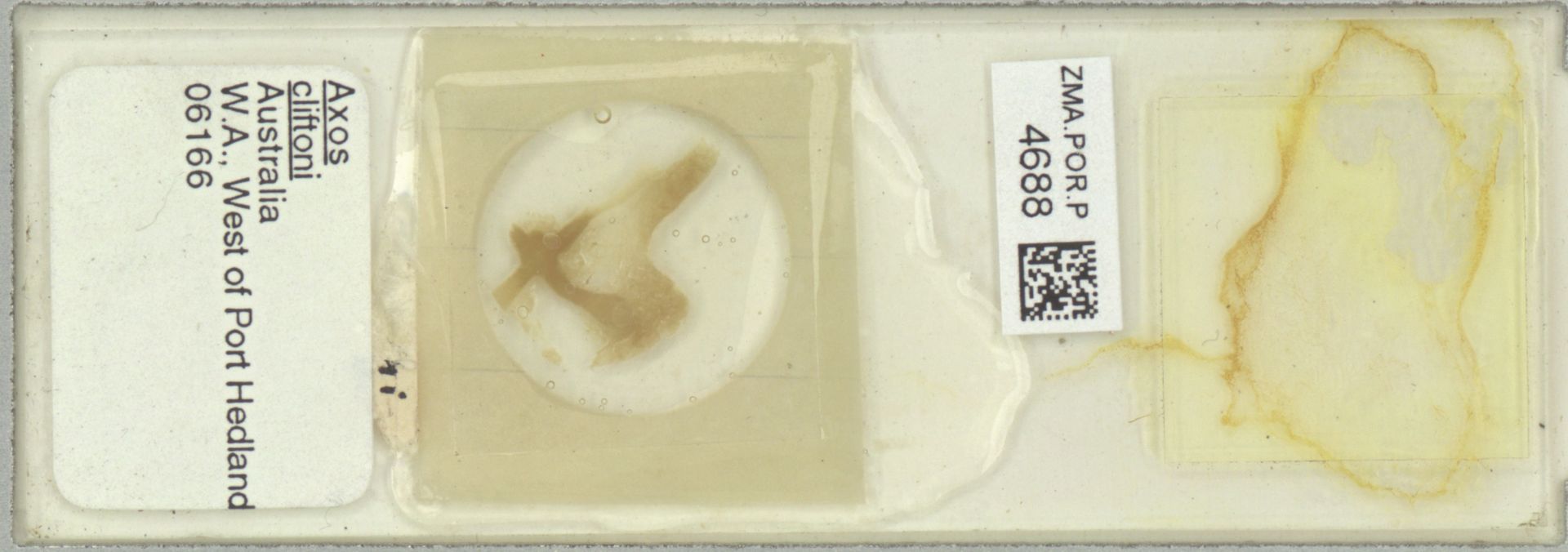
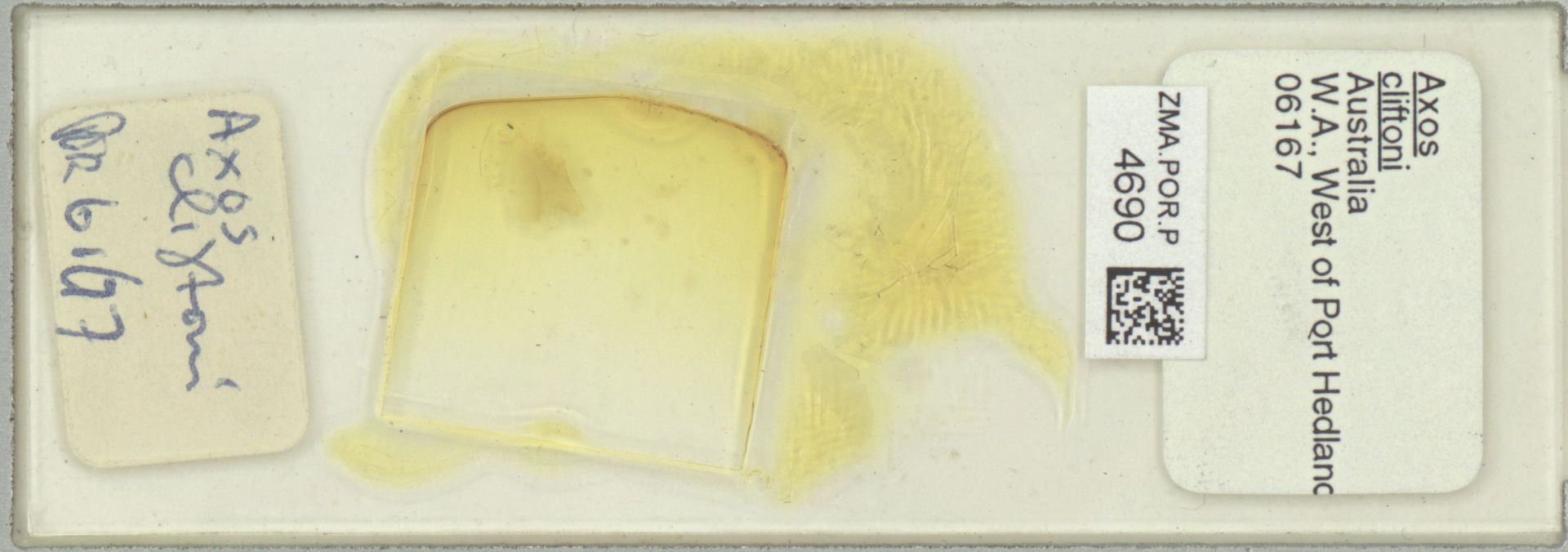
Museum specimens assigned to Axos cliftoni (collection material in the Naturalis Biodiversity Center) appear as a preserved sponge growth with a firm, encrusting to massive form rather than a free-living, highly branching morphology. The overall surface texture in the available images looks relatively smooth to finely hispid, with coloration in preservation varying from light beige to darker tan-brown patches (consistent with drying/fixation of soft tissue). One specimen image shows a more clearly delimited mass/edge, while the other shows a broader encrusting sheet-like spread across the substrate.
Distribution and type locality
Axos cliftoni is included in the sponge fauna of the Dampier Archipelago (north-western Australia). In the regional survey by Fromont, “Nickol Bay” is reported as the type locality for Axos cliftoni.
Ecology and habitat associations (generalizable)
Across the Dampier Archipelago sponge survey, habitat suitability for sponge taxa is strongly shaped by substrate type, water movement, and depth, producing pronounced small-scale mosaics among nearby stations.
Fromont’s habitat framework—useful for interpreting where members of this lineage may occur in similar settings—highlights:
- higher diversity on hard substrata such as basal pavements or coral surfaces (providing attachment points);
- stronger representation in channels/straits with good current flow;
- reduced diversity in fine silty/muddy sandy environments with few hard substrates.
For intertidal areas, sponge occurrence is associated with moisture retention and the availability of hard attachment substrata (e.g., under rocks/boulders or on partly submerged surfaces). For subtidal areas, patterns are analyzed across shallow (<10 m) versus deeper (>10 m) zones, and “sponge garden” habitats are emphasized as locally important, often linked with strong currents.
Gallery
References
- ↑ Dataset view for Animalia / Porifera / Demospongiae / Tethyida / Hemiasterellidae / Axos / cliftoni constructed from imageomics/TreeOfLife-200M records under this taxonomic path. Hugging Face Datasets. https://huggingface.co/datasets/imageomics/TreeOfLife-200M.