Athesmia
Taxonomy
- Kingdom: Animalia
- Phylum: Platyhelminthes
- Class: Trematoda
- Order: Plagiorchiida
- Family: Dicrocoeliidae
- Genus: Athesmia
Athesmia is a genus of parasitic flatworms belonging to the family Dicrocoeliidae within the class Trematoda. Established by Looss in 1899, the genus is characterized by its parasitic lifestyle.[1][2][3]
Morphology and Identification
Species within the genus are categorized into two distinct body types based on the posterior extent of the ceca relative to the vitelline field. In the 'attilae' type, both ceca extend to or surpass the posterior margin of the vitelline field. In the 'heterolechithodes' type, the cecum on the side of the vitelline field terminates near its anterior extremity, while the opposite cecum extends to or beyond the posterior margin of the vitelline field.[1]
Host Relationships
The genus includes species such as Athesmia foxi, which has been documented as a parasite of various South American primates, including members of the genera Callithrix, Cebus, Saimiri, and Saguinus.[2]
Visual Description
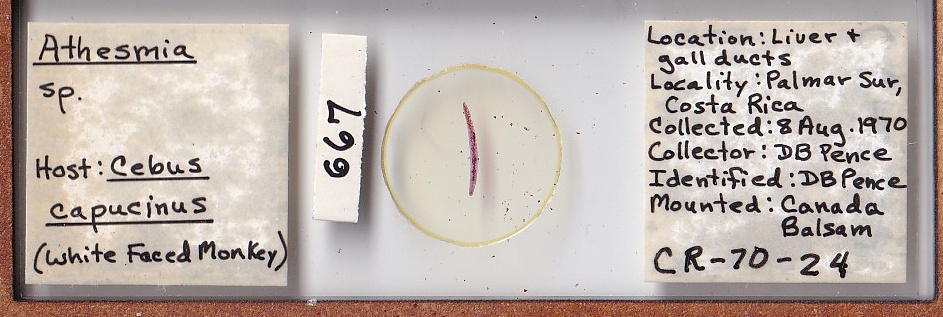
Specimens of Athesmia appear as thin, elongated, and slightly curved structures when preserved and mounted on slides. They are typically characterized by a flattened, worm-like body morphology consistent with their classification as trematodes.
Gallery
References
- 1 2 Norman O. Dronen. Keys to the species of Athesmia Loss, 1899 (Digenea: Dicrocoeliidae: Dicrocoeliinae), with the description of a new species from the clapper rail, Rallus longirostris Boddaert (Gruiformes: Rallidae), from Galveston, Texas, U.S.A.. Zootaxa. 2014. https://doi.org/10.11646/zootaxa.3815.3.2.
- 1 2 Athesmia. Global Biotic Interactions. https://www.globalbioticinteractions.org/?targetTaxon=Athesmia. Accessed 2026-09-05.
- ↑ Dataset view for Animalia / Platyhelminthes / Trematoda / Plagiorchiida / Dicrocoeliidae / Athesmia constructed from imageomics/TreeOfLife-200M records under this taxonomic path. Hugging Face Datasets. https://huggingface.co/datasets/imageomics/TreeOfLife-200M