Asteropus brasiliensis
Taxonomy
This page represents the following TreeOfLife-200M taxonomic path.[1]
- Kingdom: Animalia
- Phylum: Porifera
- Class: Demospongiae
- Order: Tetractinellida
- Family: Ancorinidae
- Genus: Asteropus
- Species: Asteropus brasiliensis
Visual Description
Asteropus brasiliensis is described as a cushion-shaped to subglobose sponge that is firm and often “minutely hispid,” frequently with embedded sediment. Oscules occur in a grouped pattern on an apical darker region.
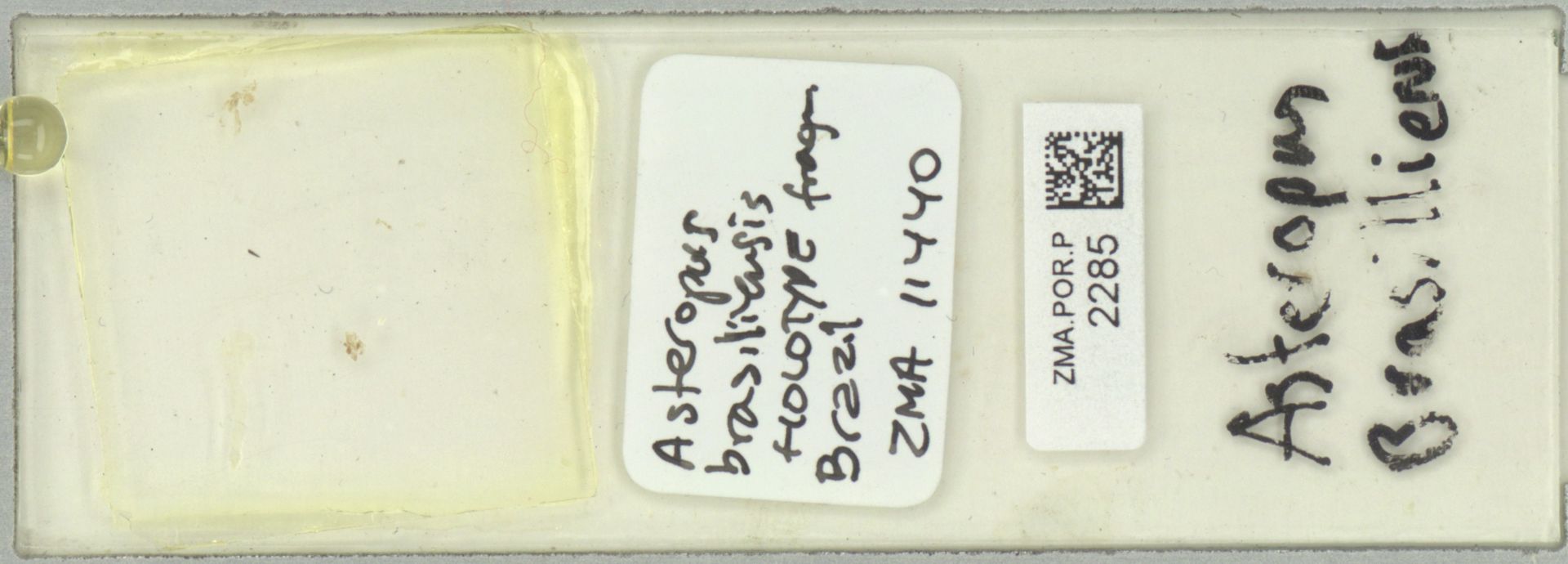
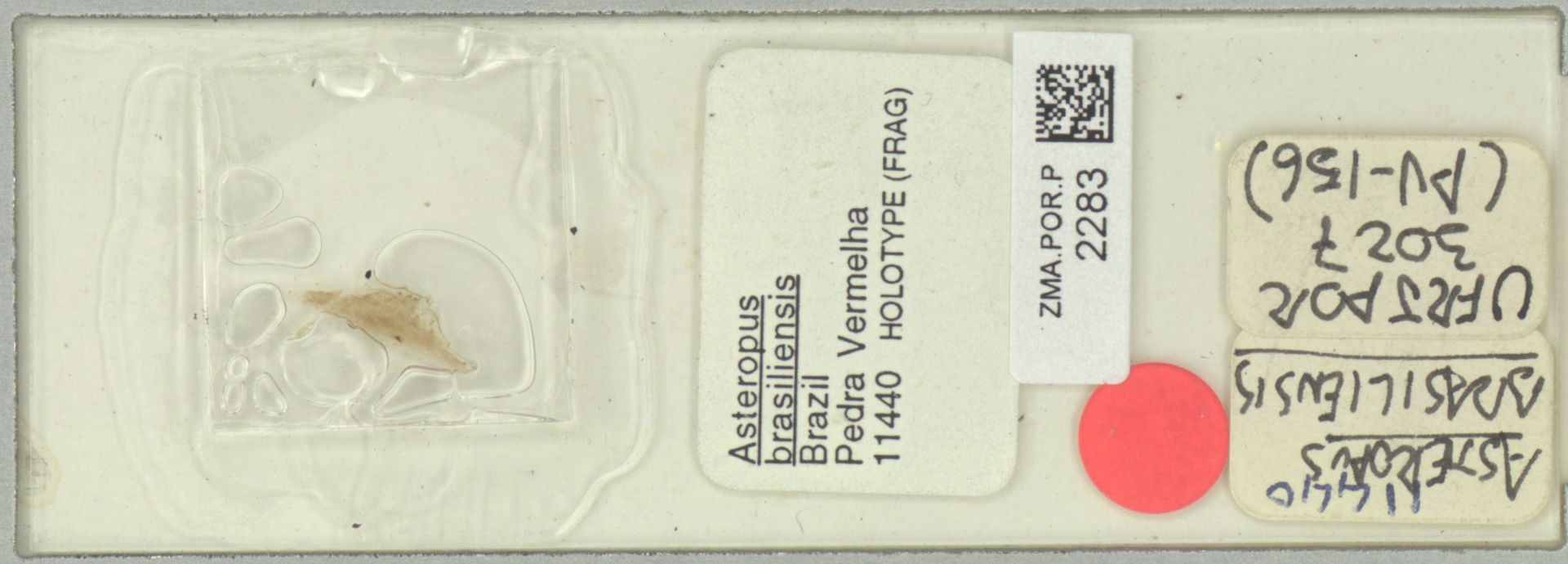
(Images in the source set show preserved museum specimens attributed to this species.)
Species Diagnosis and Morphology
Hajdu & van Soest (1992) diagnose Asteropus brasiliensis based on its growth form and spicule complement.
- Form and surface: cushion-shaped to subglobose, firm, minutely hispid; sediment may be embedded.
- Oscules: grouped on an apical darker region.
- Skeletal organization: an ectosomal crust dominated by sanidasters and reinforced by abundant small trichodragmata; an intermediary tangential oxeas layer; and a dense radial inner choanosomal skeleton of oxeas with scattered small trichodragmata.
- Spicules:
- Megascleres: oxeas with a unimodal size distribution.
- Microscleres: sanidasters spined over the rays; oxyasters spined over with rays; and trichodragmata (irregularly cylindrical/capsule-like).
- Distinguishing feature emphasized in the revision: A. brasiliensis differs from related Atlantic congeners (notably re-evaluated A. simplex records) by differences in spicule complements—especially the reported condition of only one variable category of oxea and related oxyaster-trichodragmata metrics.
Ecology and Distribution
In the tropical southwest Atlantic, A. brasiliensis is reported as relatively common in the Cabo Frio region, occurring under the zoanthid Palythoa sp. (where only the darker apical sponge portion may be visible). The species is reported from approximately 3–75 m depth.
Nomenclature and Taxonomic Status
GBIF lists Asteropus brasiliensis Hajdu & van Soest, 1992 as an accepted species name.
Gallery
References
- ↑ Dataset view for Animalia / Porifera / Demospongiae / Tetractinellida / Ancorinidae / Asteropus / brasiliensis constructed from imageomics/TreeOfLife-200M records under this taxonomic path. Hugging Face Datasets. https://huggingface.co/datasets/imageomics/TreeOfLife-200M.